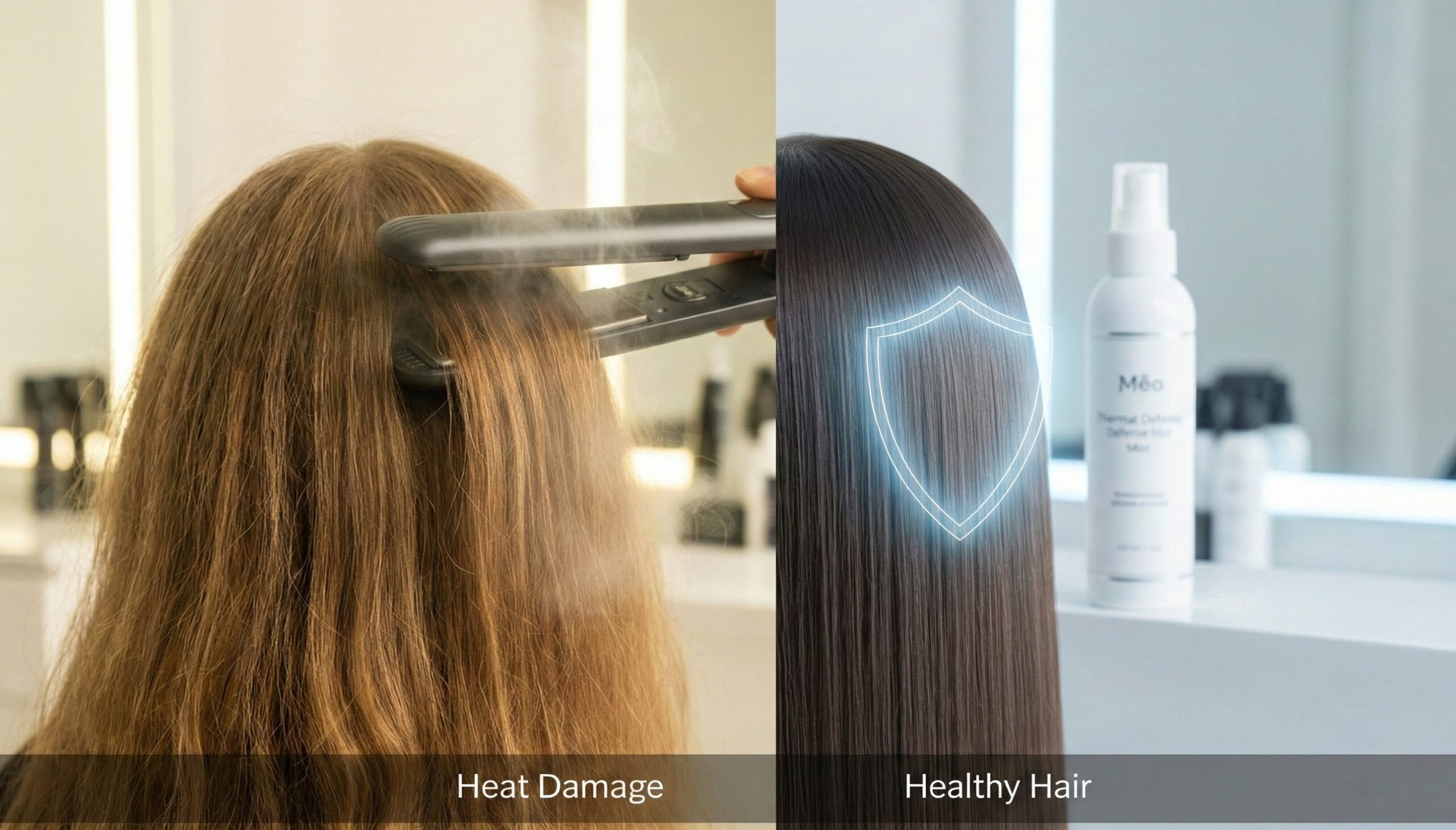
You apply heat to your hair almost every day, hoping for a sleek finish. Instead, you often end up with “sizzle,” split ends, and a dull texture that looks fried.
The high temperatures of flat irons and curling wands often reaching 450°F can literally boil the moisture inside your hair shaft. This leads to permanent structural damage that no conditioner can truly fix.
The solution isn’t to stop styling. It is to master the science of thermal barriers. By using the right formulas from meobeauty.net, you can maintain your style without sacrificing the health of your hair.
The Science of Thermal Defense: How Modern Sprays Prevent “Bubble Hair”
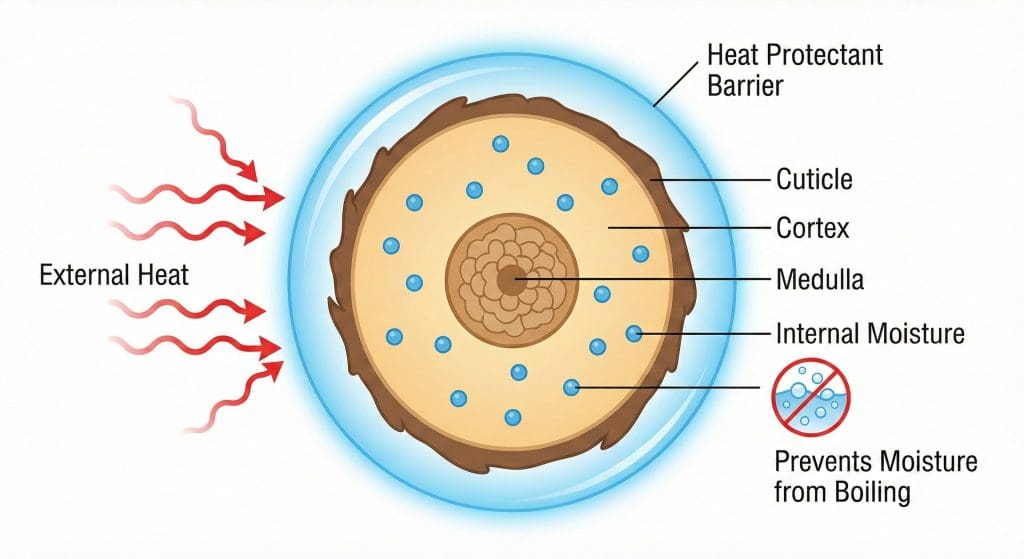
Most people think heat protectant is just a scented mist. In reality, these formulas are sophisticated insulators. They utilize thermal conductivity principles to slow down how fast heat reaches the hair’s core.
High-quality sprays create a polymer film around each strand. This film acts as a sacrificial layer. When the iron touches your hair, the spray evaporates or absorbs the energy first, protecting the cortical fibers and hydrolyzed proteins inside.
Top Picks: Matching Your Spray to Your Styling Tool
Not all heat is created equal. Your choice of product should depend entirely on the tool you are holding.
For Flat Irons (Up to 450°F): The Heavy-Duty Sealers
Flat irons offer direct, prolonged contact. You need a formula with a high 450°F barrier. Look for ingredients like Dimethicone or specialized silicones that provide high-slip surfaces to prevent snagging.
For Blowouts: Lightweight Volumizing Mists
Blow dryers use convective heat. A heavy cream will weigh your hair down and make it look greasy. Choose a weightless mist that focuses on evaporative cooling and frizz control.
For Curling Wands: Memory-Hold Protectants
Curling requires the hair to “set” in a new shape. Opt for protectants infused with light resins. These provide thermal safety while ensuring your curls don’t fall flat by noon.
| Feature | Water-Based Sprays | Silicone-Based Serums |
| Best For | Fine hair & blowouts | Thick, coarse hair & flat irons |
| Finish | Natural/Matte | High Gloss/Sleek |
| Primary Goal | Moisture retention | Surface smoothing |
| Application | Damp hair | Damp or dry hair |
Selection Guide: Choosing by Hair Porosity & Type
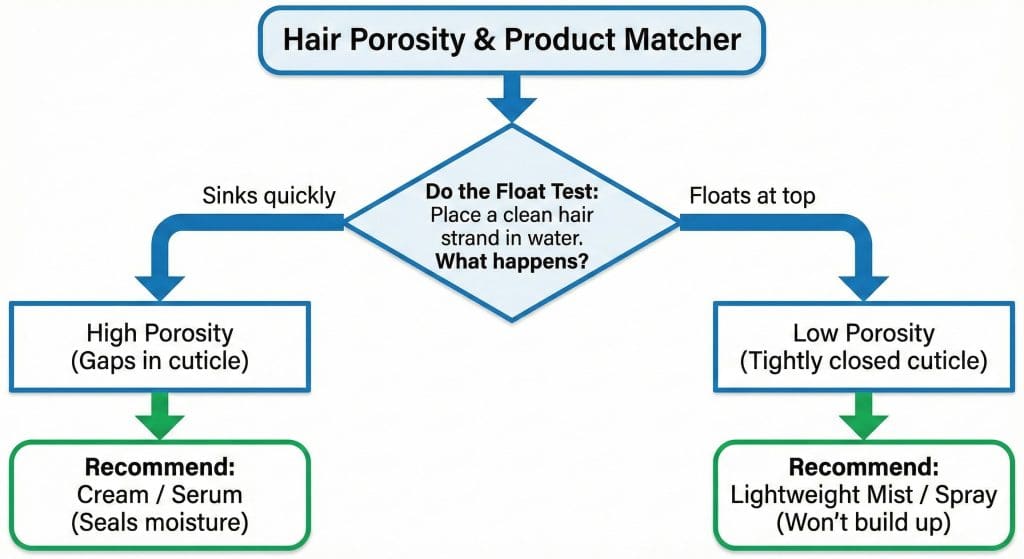
Your hair’s ability to absorb moisture—its porosity—determines which product will work.
Low Porosity hair has tightly closed cuticles. Heavy oils will sit on top and “cook” the hair. You need a water-based, lightweight mist. High Porosity hair is often damaged or color-treated. It needs creamy protectants with humectants and Argan oil to fill in the gaps in the cuticle.
Common Pitfalls: Why Your Heat Protectant Might Be Failing You
If you see steam or hear a “sizzle” when styling, something is wrong. Usually, it’s one of these three issues:
- Flash-drying: You didn’t wait for the product to settle.
- Damp Styling: Using a flat iron on hair that is still slightly wet causes “bubble hair.”
- Product Buildup: Old layers of hairspray and oil can burn, creating a sticky residue that damages the cuticle.
How to tell if your hair is burning:
- You smell a distinct “burnt toast” aroma.
- The hair feels “crunchy” immediately after the iron passes.
- You see white flakes (burnt product) on your styling tool.
Expert Application Protocol: The “Mist, Comb, Dry” Method
Proper application is just as important as the product itself. Follow this professional routine used by experts at meobeauty.net:
- Section Your Hair: Divide your hair into at least four quadrants.
- Saturation is Key: Mist each section from about 6 inches away. Ensure the middle and ends are thoroughly coated.
- Comb Through: Use a wide-tooth comb to distribute the product. This ensures no strand is left unprotected.
- The Wait Rule: Never touch a hot iron to wet hair. Let the spray dry or use a blow dryer on a cool setting first.
FAQ: Heat Protection Essentials
Do heat protectant sprays actually work?
Yes, they work by creating a thermal barrier that slows heat conduction and prevents moisture loss. They use polymers to distribute heat evenly, protecting the hair’s keratin bonds and reducing breakage significantly.
Can I use heat protectant on dry hair?
Only if the product is specifically labeled for dry application. Most sprays need to be applied to damp hair for even distribution. Using a “wet” spray on dry hair right before flat-ironing can cause steam damage.
Is hair oil a substitute for heat protectant?
No. Most natural oils have low smoke points and lack the thermal-reflective polymers found in professional sprays. Using raw oil alone can actually accelerate heat damage by “frying” the hair strand.
What temperature requires a heat protectant?
Any tool exceeding 300°F (150°C) requires protection. Hair proteins begin to denature at this temperature. If you style at 400°F or higher, a professional-grade shield is mandatory to avoid permanent damage.