You finally bought a bottle of retinol. It’s sitting on your bathroom counter right now. But instead of excitement, you feel a little nervous.
You’ve heard the horror stories. The peeling. The redness. The dreaded “retinol burn” that makes your face feel like it’s on fire. It’s enough to make anyone hesitate.
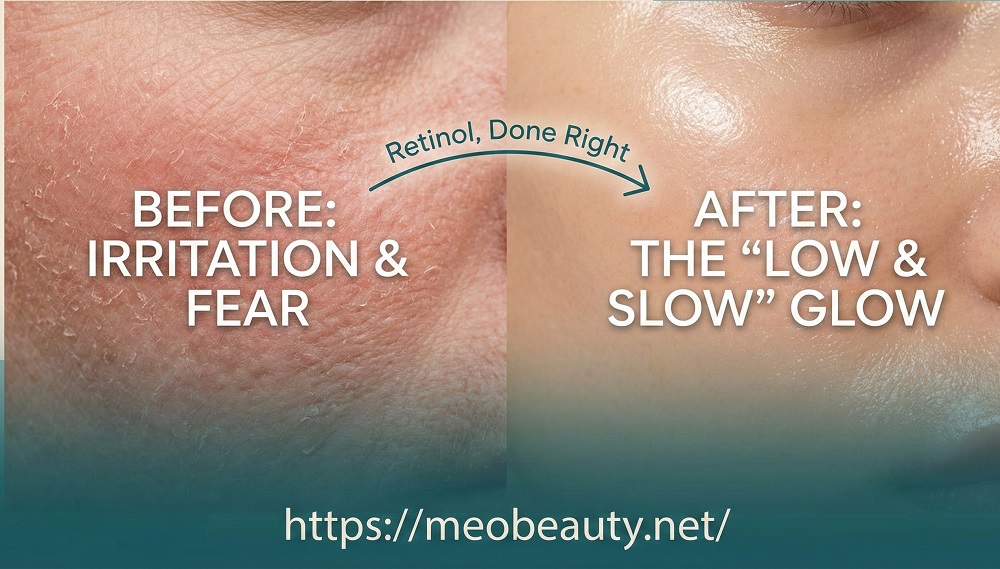
But here is the truth: Retinol doesn’t have to hurt to work. The “ugly phase” isn’t a requirement; it’s usually a sign of doing too much, too soon. At Meo Beauty, we believe in barrier-first skincare. By following a strict, low-dose protocol, you can bypass the irritation entirely and go straight to the glow.
Here is your roadmap to starting retinol safely.
What Does Retinol Actually Do to Your Skin?
Before you apply it, you need to understand the mechanism. Retinol is a derivative of Vitamin A. It isn’t just an exfoliator that scrubs the surface; it communicates with your cells.
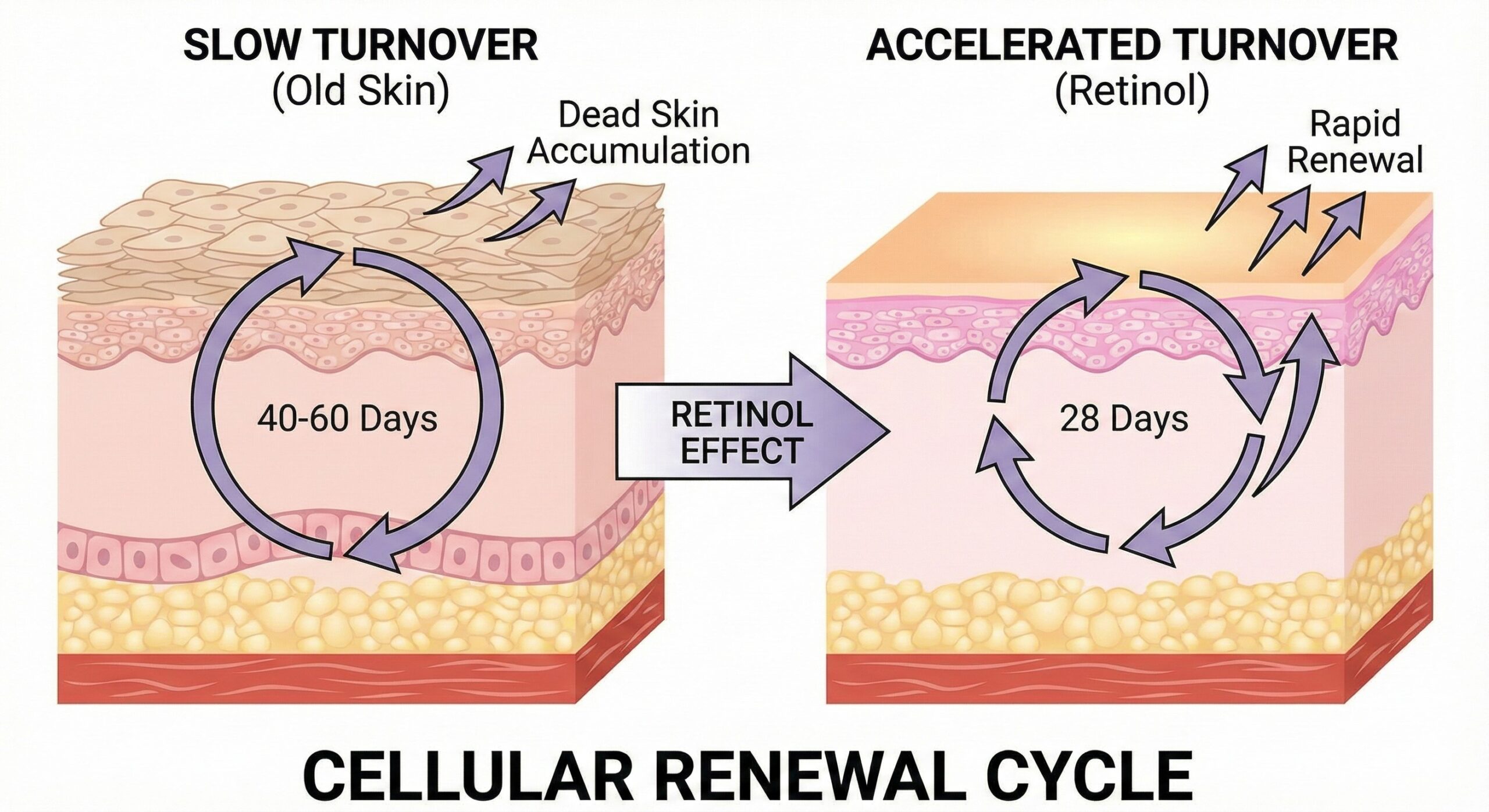
When absorbed, retinol accelerates cellular turnover. It tricks your skin into thinking it’s younger, forcing it to produce fresh cells faster and push them to the surface. It also stimulates collagen production deep in the dermis.
The irritation happens when this signal is too loud. Your skin barrier (the stratum corneum) can’t keep up with the rapid turnover, leading to cracks, dryness, and flaking. Our goal is to introduce this signal as a whisper, not a shout.
The Golden Rule: The “Low and Slow” Approach
If you remember only one thing from this guide, make it this: More is not better.
Using more product won’t erase wrinkles faster. It will only damage your moisture barrier. The key to zero irritation is controlling two variables: Amount and Frequency.
1. The Pea-Sized Limit
You need exactly a pea-sized amount for your entire face. That is roughly 0.25 grams. It looks deceptively small, but retinol migrates under the skin.
-
Dot the product on your forehead, cheeks, and chin.
-
Gently spread it.
-
Avoid the sensitive eye area and the corners of the nose.
2. The 4-Week Frequency Schedule
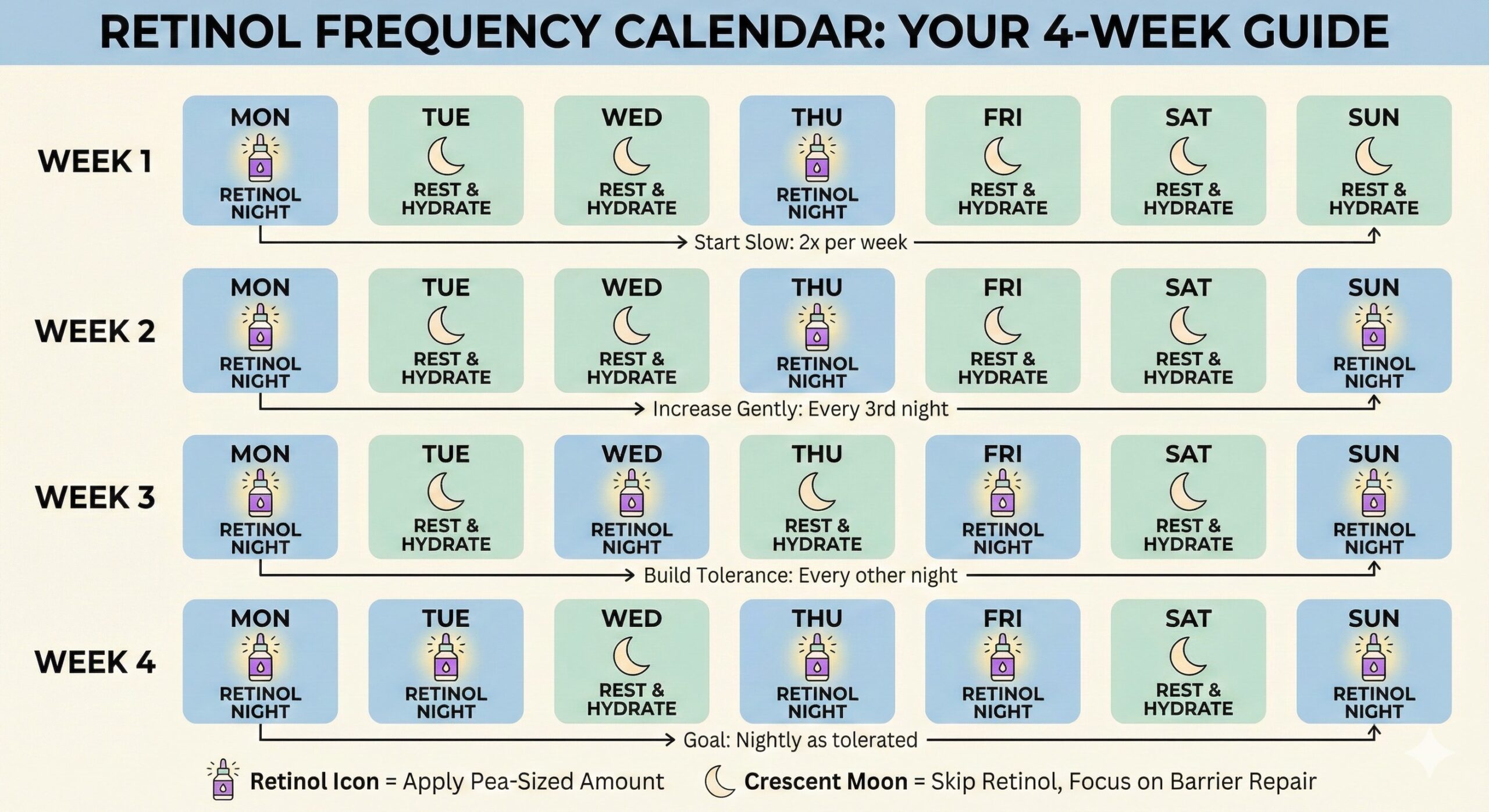
Do not start using it every night. Your skin needs time to build tolerance (a process called retinization).
-
Week 1 & 2: Apply only two nights a week (e.g., Monday and Thursday).
-
Week 3: Apply every other night.
-
Week 4: If you have zero dryness, try nightly application. If you feel tight or dry, stay at “every other night” indefinitely.
The “Sandwich Method”: Your Safety Net Against Dryness
If you have sensitive skin, applying retinol directly to dry skin might be too harsh. Enter the Sandwich Method.
This technique buffers the active ingredient, slowing down its absorption rate without rendering it ineffective. It ensures your hydration levels stay high while the retinol works.
How to do it:
-
Base Layer: After cleansing, apply a lightweight moisturizer. Let it dry completely.
-
The Active: Apply your pea-sized amount of retinol.
-
The Seal: Immediately follow with a heavier moisturizer (ideally one with Ceramides) to lock everything in.

Choosing the Right Beginner Retinol
Not all Vitamin A products are created equal. As a beginner, you want to avoid high-strength prescription Tretinoin until your skin is ready.
Look for Encapsulated Retinol. This technology wraps the active ingredient in a protective shell that dissolves slowly over time, releasing the retinol gradually rather than all at once.
| Feature | Beginner Choice | Advanced Choice |
| Concentration | 0.01% – 0.03% | 0.1% – 1.0% |
| Delivery System | Encapsulated / Slow-Release | Pure / Direct Acid |
| Texture | Cream or Oil-based (Hydrating) | Gel or Serum (Fast Absorbing) |
| Best For | First-time users, Sensitive skin | Acne-prone, Thick skin, Veterans |
The “Purge” vs. Irritation: How to Tell the Difference
You might see a few pimples pop up in the first few weeks. This is often the Retinol Purge. Because cell turnover is speeding up, clogs deep in your pores are being pushed to the surface faster than usual.
However, you must distinguish between a helpful purge and a harmful reaction.
-
The Purge: Occurs in areas where you usually break out. Pimples heal faster than normal. No stinging.
-
Irritation/Reaction: Redness, burning, stinging when applying other products, or breakouts in new areas.
If you experience irritation, stop immediately. Focus on barrier repair (hydration and ceramides) for a week before trying again—this time, even slower.
Frequently Asked Questions
How do I start using retinol without ruining my skin?
Adopt the “Low and Slow” approach and buffer with moisturizer. Start with a low concentration (0.01%) applied only twice a week. Always apply to dry skin, or use the “Sandwich Method” (moisturizer before and after) to reduce the risk of barrier damage.
What is the retinol sandwich method?
It is a buffering technique involving three layers: Moisturizer, Retinol, then Moisturizer. You apply a base layer of hydration, let it dry, apply your retinol, and then seal it with a second layer of cream. This slows absorption and prevents dryness.
How long does the retinol purge last?
The purge typically lasts between 2 to 6 weeks. It is a temporary phase where increased cell turnover pushes clogged pores to the surface. If breakouts persist beyond 8 weeks or are accompanied by burning, it is likely irritation, not purging.
Can I use Vitamin C with Retinol?
Yes, but not at the same time. Use Vitamin C in the morning to protect against UV damage and free radicals. Use Retinol at night to repair the skin. Mixing them directly can cause pH imbalance and severe irritation.
How much retinol should I actually use?
Use exactly a pea-sized amount (0.25 grams) for the entire face. Using more does not improve results; it only increases the risk of side effects like redness and peeling. Dot it evenly across the face before blending.
For more expert skincare guides and product reviews, visit us at Meo Beauty.