Do you feel like you need a chemistry degree just to buy a toner? You aren’t alone. One scroll through skincare TikTok will show you thousands of “shelfies” featuring colorful bottles of acids, all promising glass skin. But picking the wrong one is the fastest way to wreck your skin barrier.
If you are still scrubbing your face with walnut shells or apricot pits, stop immediately. Physical scrubs cause micro-tears in the skin. The modern, dermatologist-approved standard is chemical exfoliation, using controlled acids to dissolve dead skin cells without the abrasion.
At Meo Beauty, we believe in a “Barrier-First” approach. You don’t need to burn your face to see results. This guide will decode the science of AHAs and BHAs so you can choose the right bottle for your bathroom shelf.
The Basics: What Is Chemical Exfoliation?
Your skin naturally sheds dead cells in a process called desquamation. When you are young, this happens quickly. As you age, this process slows down, leaving old cells “glued” to the surface. This leads to dullness, clogged pores, and rough texture.
Chemical exfoliants are acids that dissolve the “glue” holding these dead cells together. Unlike physical scrubs, which just scratch the surface, chemical exfoliants work evenly and can even penetrate pores to clean them from the inside out.
Meet the AHAs (Alpha Hydroxy Acids)
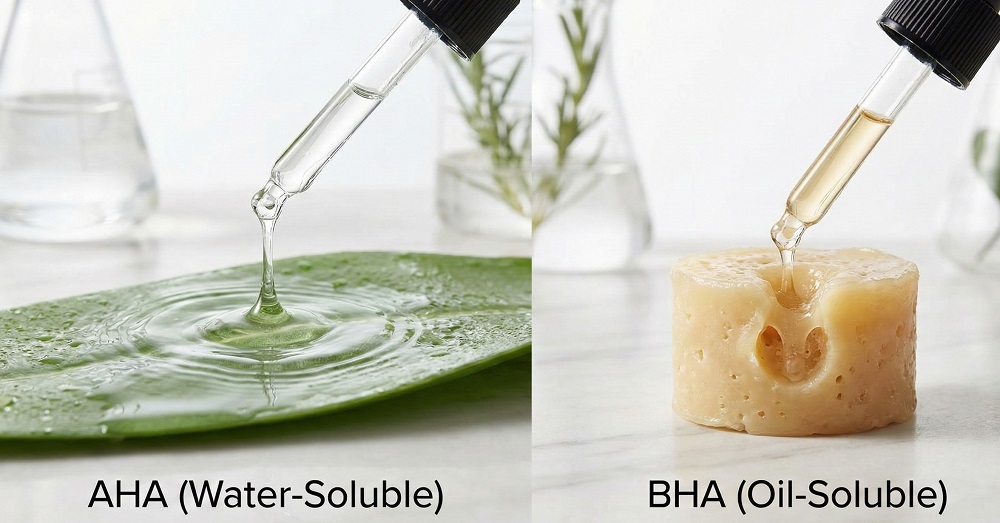
AHAs are water-soluble acids derived from sugary fruits. They are surface workers. Because they love water, they work primarily on the top layer of the skin (the epidermis).
Who Should Use AHAs?
If your skin is dry, sun-damaged, or dull, AHAs are your best friend. They peel away the dry, flaky top layer to reveal fresh skin underneath. They are also humectants, meaning they help hold moisture in the skin.
Common AHA Types:
-
Glycolic Acid: The gold standard. It has the smallest molecule size, allowing it to penetrate fast for quick results.
-
Lactic Acid: Gentler and more hydrating. Perfect if Glycolic feels too spicy for your skin.
-
Mandelic Acid: The gentle giant. Derived from almonds, it has a large molecule size that penetrates slowly, making it safe for sensitive skin.
Meet the BHAs (Beta Hydroxy Acids)
BHAs are oil-soluble acids. This is their superpower. While AHAs stop at the surface, BHAs can cut through the oil (sebum) on your face and dive deep inside your pores.
The Magic of Oil Solubility
Once inside the pore, BHAs dissolve the mix of oil and dead skin that causes blackheads and whiteheads. They are also anti-inflammatory, which helps calm the redness associated with active breakouts.
Who Should Use BHAs?
If you have oily skin, blackheads, enlarged pores, or acne, you need a BHA.
Common BHA Types:
-
Salicylic Acid: The most common BHA. You will find it in everything from cleansers to spot treatments.
-
Betaine Salicylate: A gentler alternative often found in K-Beauty products.
AHA vs. BHA: What’s the Main Difference?
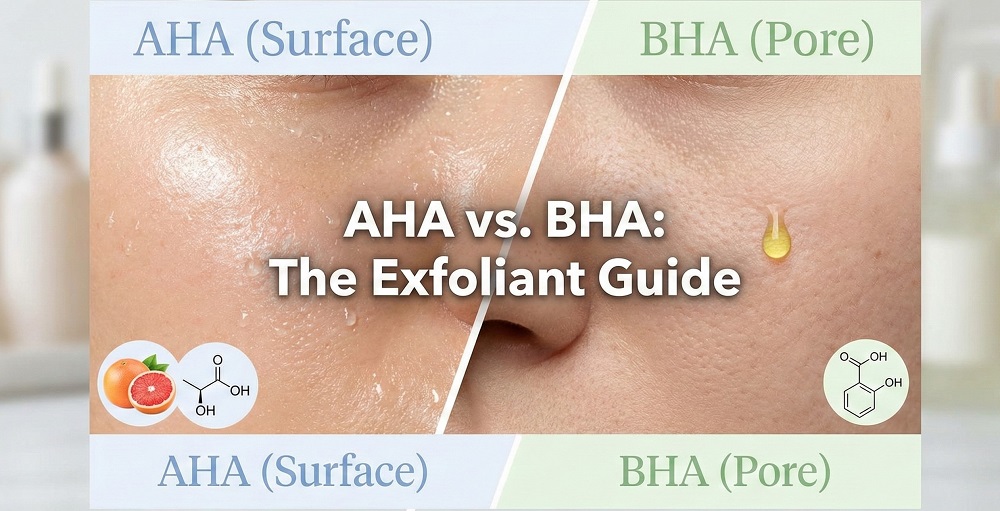
If you only remember one thing, remember this: AHA is for surface glow; BHA is for deep cleaning.
| Feature | AHA (Alpha Hydroxy Acid) | BHA (Beta Hydroxy Acid) |
| Solubility | Water-soluble | Oil-soluble |
| Action | Surface exfoliation (peeling) | Deep pore penetration (unclogging) |
| Best For | Dryness, Sun Damage, Dullness | Oily Skin, Acne, Blackheads |
| Key Benefit | Hydration & Glow | Anti-inflammatory & Clearing |
| Example | Glycolic, Lactic Acid | Salicylic Acid |
How to Choose the Right Exfoliant for Your Skin Type
Don’t guess. Use this simple “Meo Beauty Cheat Sheet” to pick your fighter.
-
Dry or Dehydrated Skin: Choose Lactic Acid (AHA). It removes flakes while boosting hydration.
-
Oily or Acne-Prone Skin: Choose Salicylic Acid (BHA). It clears the oil causing your breakouts.
-
Sensitive Skin: Choose Mandelic Acid (AHA) or PHAs. These are larger molecules that work slowly without irritation.
-
Combination Skin: You can use both (see the next section) or look for a product that combines low percentages of both.
Can You Use AHA and BHA Together?
Yes, but proceed with caution. The risk here is over-exfoliation, which damages your moisture barrier and causes more acne.
The Danger of Mixing
Layering a strong AHA serum directly on top of a strong BHA toner is usually too harsh. It strips the skin of necessary oils and changes the pH too drastically.
How to Alternate Safely (Skin Cycling)
The safest method is “Skin Cycling.”
-
Night 1: Use your Exfoliant (AHA or BHA).
-
Night 2: Use a Retinol (if you use one).
-
Night 3 & 4: Recovery. No actives, just hydration and barrier repair.
If you have very tolerant, oily skin, you might alternate nights: AHA on Monday, BHA on Tuesday. Always listen to your skin.
Common Mistakes & Aftercare
Once you start using acids, you must change your routine to protect your fresh skin.
-
Sunscreen is Non-Negotiable: AHAs make your skin photosensitive. You burn faster. If you don’t wear SPF 30+ daily, you are undoing all the benefits of the exfoliation.
-
Purging vs. Breaking Out: When you start, you might see more pimples for 2-4 weeks. This is called “purging”—it’s the gunk coming to the surface. If it lasts longer than a month, or happens in places you don’t usually break out, it’s likely irritation. Stop using the product.
-
Don’t Overdo It: “Tingling” is okay; “Burning” is bad. If your skin stings when you apply moisturizer, you have over-exfoliated. Take a break for a week.
FAQ: Common Questions on Exfoliation
What is the main difference between AHA and BHA?
The main difference is solubility. AHAs are water-soluble and work on the surface to improve texture and moisture (great for dry skin). BHAs are oil-soluble and penetrate deep into pores to clear acne and oil (great for oily skin).
Can I use AHA and BHA together?
Yes, but it is best to alternate nights. Layering them simultaneously can cause irritation. Try “Skin Cycling”: Use AHA one night, BHA the next (or a few nights later), and always include “recovery nights” with just moisturizer to protect your barrier.
Which is better for acne, AHA or BHA?
BHA (Salicylic Acid) is better for acne. Its oil-soluble nature allows it to dive inside the pore to dissolve the sebum and keratin plugs that cause pimples. AHAs help fade the dark spots after the acne heals, but BHAs stop the breakout at the source.
Do I wash off AHA or BHA exfoliants?
Usually, no. Most toners and serums are “leave-on” treatments. However, high-strength “peeling solutions” (like 30% AHA masks) must be washed off after 10 minutes to prevent chemical burns. Always read the label.
Can I use Vitamin C with AHA or BHA?
Use them at different times. A common dermatologist-recommended routine is to apply Vitamin C in the morning (for protection) and your AHA or BHA at night. Mixing them directly can destabilize the Vitamin C or cause stinging.
Ready to start your journey to clear skin? Check out Meo Beauty’s top-rated routine guides for more science-backed tips.